
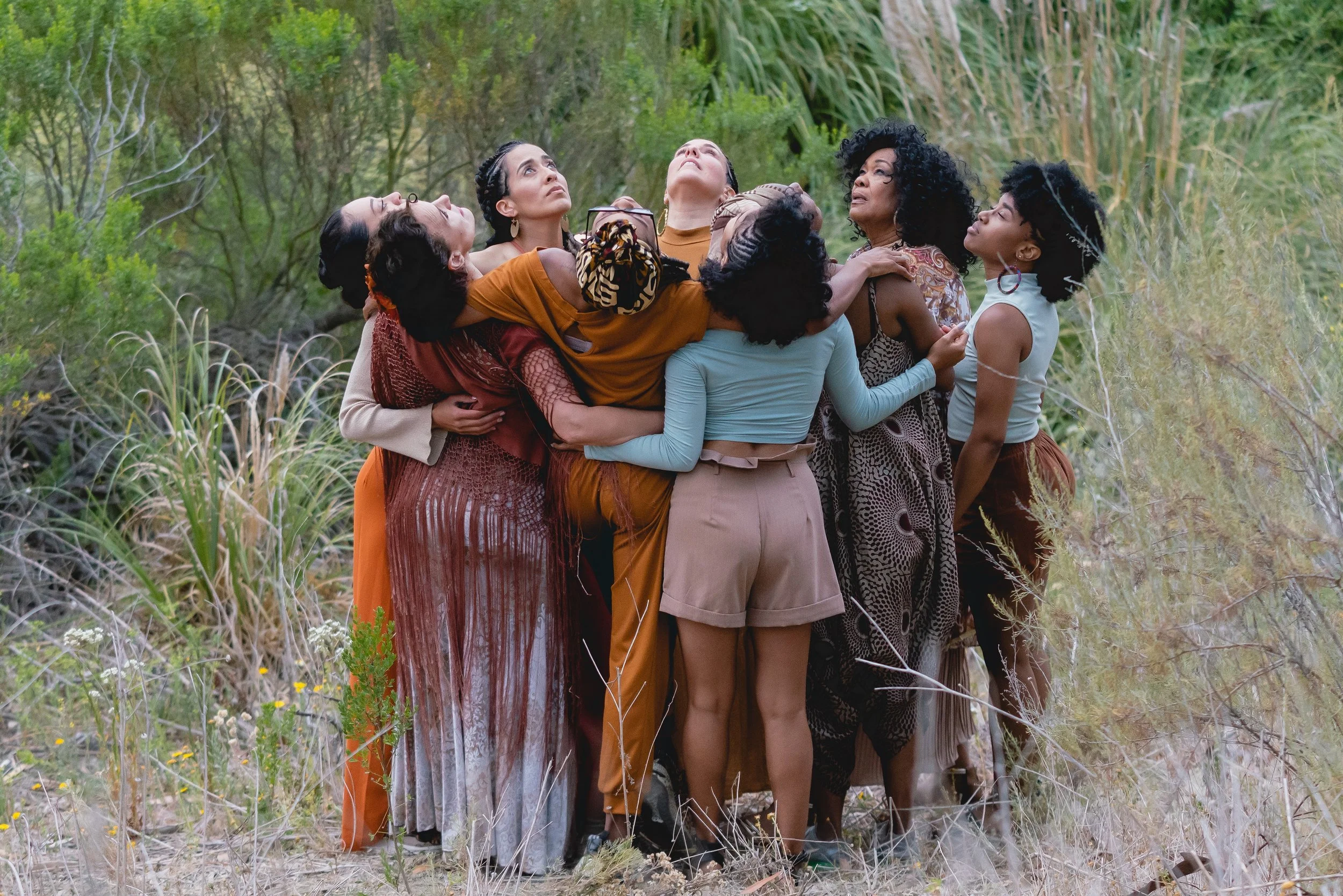
Voices del Camino: Dancing Out on Faith

On the series: Voices del Camino is our series of stories and reflections from the company, while on tour. El camino, in Spanish, literally means "the road"; but el camino is also the journey that we're on towards witnessing, creating, and sharing the beauty and complexity of humanity, and towards transforming our world through love and movement. 

Stop 1: MIDLAND, TX | Dancing Out On Faith... by Samad Raheem Guerra

Initially, I had questions about the way that our work might be received in Midland, Texas - a predominately Christian town with very liberal gun laws. How would a piece like "Agua Furiosa" sit with people, I wondered. All of my concerns seemed to fly out the door as soon as we arrived at bag-check. We were greeted by the nicest man, Mr. Fuller, who turned out to be the husband of Robbyne Hocker Fuller, one of our presenters. He introduced us to Pastor Hale and then briefly explained the strong network of faith-based communities, the Midland African American Roots Historical Cultural Arts Council (MAARHCAC), that rallied together on our behalf to make sure that we could perform in Midland. I immediately felt at home with Mr. Fuller and Pastor Hale and had questions about the role that faith plays in the African-American community in Midland. I wondered if they knew that "Agua Furiosa" conjures up the spirit of Oyá, a deity in Africa and the Diaspora, who narrates the story from Her perspective. 

Pastor Hale told me that Midland, like other small towns in Texas, faith is the binding force that keeps people connected to each other, regardless of their differing political views. We also learned that faith-based organizations like the MAARHCAC, are heavily involved in local politics in Midland. Mrs. Fuller, for example, has helped educate residents about policies affecting the environment and real-estate. 


Later in the week we were given copies of The Weekender, a local guide to events in Midland. On the front page was a picture of me and a large caption that read: Contra Tiempo brings themes of social justice. Whether anyone knew that some of the dances presented in our work embody African deities didn't worry me. I was excited to perform and couldn't wait to hit the stage! Before getting to my place, I peered into the audience and smiled at the almost-full crowd of predominately Black and Brown faces, young and old. If this is what faith can do, I thought, I want to be a part of it.  

Mr. Fuller sat us all down and reminded us of the importance of the work we are doing. “It’s God’s work,” he said, and the work of a true artist.
After my solo, the crowd clapped, which had never happened before. It must have landed and resonated with people in a way that it hadn't before. A Council member approached me after the show and said that we were the best thing that's come to Midland in a long time. I gave her a hug and introduced myself to her son, an aspiring performer. Before heading out, Mr. Fuller sat us all down and reminded us of the importance of the work we are doing. "It's God's work," he said, and the work of a true artist. 

REACTIONS TO AGUA FURIOSA

Your thoughts and reactions to the work that we create fuels our creative process as much as the stories that we collect and embody in our work. We sincerely believe that through experiencing art and through engaging in genuine conversations about what that art raises for us, humanity can heal and transform. 

Agua Furiosa takes on some huge, heavy themes: racism, objectification of the female body, internalized oppression and internalized racism, wasteful consumption, to name a few. Please use the comments as a space for sharing questions, sharing reactions and thoughts, and engaging with each other, as we grapple with all of these themes.  

What did you see and experience in the piece?

What were the points of tension you felt?

Which Caliban resonated most with you? Why?

Which Caliban did you not connect with or understand?

Who was Ella, to you, and what did you think she wanted from her children?

What confused or bothered you?


AGUA FURIOSA RESOURCES

Agua Furiosa has been in conceptual development since 2012. Over these almost four years, there have been countless texts, stories, songs, dances, images and conversations that inspired the work. Here we have listed some of that inspiration, from Artistic Director/Choreographer, Ana Maria Alvarez, sound designer, d. Sabela grimes, and chanteuse, Pyeng Threadgill. As well, there are resources to learn more about the themes of the work. 

Audre Lorde

Audre Lorde

Racism/Sexism

  • The Master's Tools Will Never Dismantle the Master's House, an essay by a fierce Black Feminist Lesbian activist and scholar, Audre Lorde
  • Sojourner Truth, an African American woman who survived chattel slavery to become one of the most renowned human rights activists in our nation's history
  • What is Internalized Racism?, an essay by Donna K. Bivens on one of the themes explored especially by Calibans 2 and 3, internalized oppression and racism
  • The People's Institute for Survival and Beyond, a trusted organization that is doing important work on "undoing racism". They describe themselves as "a collective of anti-racist, multicultural community organizers and educators dedicated to building an effective movement for social transformation". They offer outstanding workshops around several critical race-related issues.

Water/Environment

Oyá

Oyá

  • Oyá | Oyá is an Orisha, in the Afro-Cuban tradition of Santeria (or Lukumí), a tradition that was brought to Cuba from Nigeria when Yoruban people were enslaved through the Trans- Atlantic slave trade. Oyá is the deity of the wind, the air, lighting, fertility and magic. Oftentimes referred to as a destroyer, Oyá represents more the spirit of change, transition, and chaos. She is associated with the marketplace and the gates of cemeteries, which reveal Oyá in her aspect as facilitator of transition and transformation. She is a queen and a warrior orisha. In Yoruba, Oyá literally means “She Tore”. She is also called “the one who wears pants to go to war“. There are a number of websites that provide general information about Oyá, however, we cannot verify the accuracy of the information on these sites. 
  • The Tempest |  The Tempest, is considered to be one of William Shakespeare's greatest works. Written while Europe was colonizing the Americas, The Tempest is thought of as Shakespeare's in-depth discussion into the morality of colonialism and has been the subject of feminist critique, due to the lack of female voices in the play.  Alvarez created Agua Furiosa as a counter narrative to The Tempest, taking on many of the themes of the original play (magic, justice, "the soul") but from a clear female and contemporary perspective.  The work calls on two distinct characters of the play:
  1. Caliban, a disfigured slave; his name is connected to the word Cannibal, which is derived from “Carib”, the term then used for natives in the West Indies. In The Tempest, Caliban is very much in touch with the natural world, but demonized and not considered fully human.
  2. Sycorax, the mother of Caliban, one of the less-prominent women mentioned in The Tempest, is only described by the men of the play and never given body or voice. Woven throughout these descriptions of her is a suspicion of woman as evil, malicious and untrustworthy.


Musical Inspiration

The following artists were specifically identified by d. Sabela grimes as inspirations for Agua Furiosa's soundtrack: 

  • Celia Cruz- Quimbara
  • Duke Ellington
  • Fatoumata
  • Diawara
  • Petey Pablo
  • Kev Carmody
  • Soledad Bravo
  • Afrekete/Javier Campos Martinez