
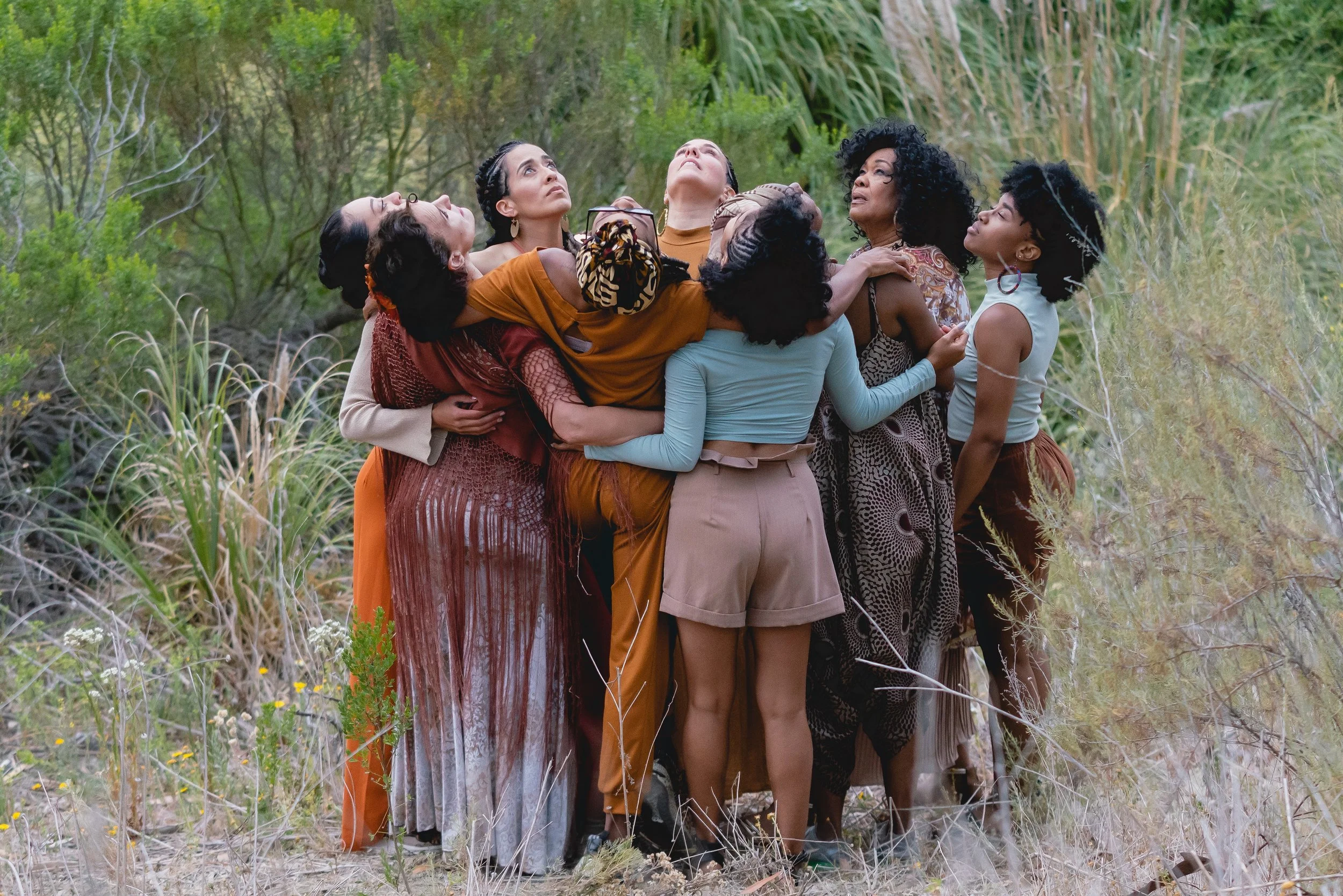
The Movement Was Always Ours
On women, activism, and the price of holding it all together.
“The burden of protecting social movements from the abusive men within them has always fallen on women.”
This week, Dolores Huerta - 95 years old, a living legend, the woman who gave us “Sí, se puede!” - told the world a truth she had carried for sixty years. That the man she built the farmworker movement with raped her. That she stayed silent because she believed the movement would not survive the telling. That she bore two children from those encounters and arranged for them to be raised by other families. That she poured all of it - the grief, the violation, the impossible choice - into decades of organizing so that farmworkers could live with dignity.
We are heartbroken. We are not surprised. And we need to say something clearly from the start: this is not a story about what happens in activist spaces. This is a story about what happens everywhere. In schools and universities. In boardrooms and law firms. In financial institutions and hospitals. In government offices and houses of worship. In Hollywood and in the fields. The abuse of women by powerful men is not a failure of progressive movements - it is the air that every institution in this society breathes. What we expect from movements rooted in liberation and equity is that we do better. That we hold ourselves to a higher standard. That we refuse to let the cause become a cover for harm.
That is the distinction. And it matters enormously right now.
A Pattern Older Than Any Movement
The story of women building the world while surviving harm from men within it is not new. It is not exceptional. It is endemic - woven into the fabric of every institution humans have constructed.
Women show up first. Women do the unglamorous work. Women hold the relationships, remember the names, make the phone calls, keep the doors open. In movements and in corporations, in classrooms and in courtrooms, women absorb harm - in silence, for the sake of the institution, for the sake of the cause, for the sake of everyone except themselves.
Dolores Huerta carried that silence for six decades. Not because the farmworker movement was uniquely broken, but because the world she lived in - the same world we live in - told her that her pain was a threat to everyone else's liberation. That is not solidarity. That is not movement. That is the same calculus that has silenced women in every boardroom, every campus, every church, every courthouse in America.
We are also living through a moment when the silence is being enforced at the highest levels of government. Last week, the United States became the only country in the world to vote against the UN Commission on the Status of Women's Agreed Conclusions - a document focused on ensuring access to justice for women and girls that had been adopted by consensus for nearly 70 years. Thirty-seven nations voted in favor. One voted against. Ours.
This is not background noise. This is the context in which Dolores Huerta came forward. This is the world in which survivors are choosing to speak. And we must name it.
A Word of Caution
We have to say something uncomfortable. THe same forces that voted against women’s rights at the UN, that are dismantling reproductive healthcare, that are defunding gender equity programs across this country - those forces will use Dolores Huerta’s bravery as a weapon. They will point to her story and say: see, your movements are rotten. See, your heroes are frauds. See, those people cannot be trusted.
We refuse that framing. Completely.
Huerta's courage in speaking her truth does not discredit the farmworker movement - it clarifies it. It names what has always been true: that liberation movements, like all human institutions, can harbor abusers. The answer is not to abandon the movements. The answer is to build them better. To center survivors. To refuse the silence that protects powerful men at the expense of the women who built everything around them.
Some will weaponizes survivors' stories to destroy movements. We honor survivors' stories to strengthen them.
What This Means for Us
CONTRA-TIEMPO was founded by a woman. It is led by a woman. Our ensemble is majority women and femme. The stories we tell, the bodies we center, the futures we imagine - they are shaped by women's ways of knowing, women's forms of resilience, women's insistence that joy and justice belong together.
We have not been immune to the dynamics that play out in every corner of this society - andyes, in movement spaces too. We know what it feels like to be in rooms where women's voices are talked over, where women's concerns are footnoted, where women's bodies are treated as resources rather than as sovereign. We know what it costs to name it. We know what it costs not to.
““We will not build a liberation that requires women to sacrifice themselves first.””
That is precisely why we do this work the way we do it. Not as a workaround for the harder conversations, but as a daily practice of building something different. Where women lead. Where survivors are believed. Where no one is asked to choose between their safety and their cause.
Undoing Patriarchy - Even in Ourselves
Here is the harder conversation. One that women-led organizations don't always want to have, but that we believe is essential: being led by women does not automatically make a space free of patriarchy.
Patriarchy is not just a set of behaviors that men enact on women. It is a system that all of us -regardless of gender - have been trained to internalize. It lives in the way we measure success. In who gets credit and who gets erased. In the assumption that leadership means being the loudest, the most certain, the one who never needs rest. In the culture of overwork and martyrdom that we sometimes mistake for dedication. In the competition between women that the system manufactures to keep us from building with each other.
We have seen women in power replicate the very hierarchies they suffered under - not out of malice, but out of habit. Out of survival. Out of having learned, in a world built by and for men, that the only way to lead is to lead like a man.
Undoing that takes more than intention. It takes practice. It takes accountability structures that don't rely on one person's goodness. It takes asking, regularly and honestly: whose voices are missing from this room? Whose labor is invisible? Who is absorbing the harm so that the rest of us can move forward?
““A women-led organization is not automatically a liberated one. Liberation is a daily practice, not a credential.””
At CONTRA-TIEMPO, these are not rhetorical questions. They are ones we return to, imperfectly and persistently, as part of the work of being the organization we say we are. We don't always get it right. But we keep asking.
Toward Matriarchy - and the Divine Feminine in Movement
What would it actually look like to build from a different foundation? Not just to remove harmful men from positions of power, but to replace the logic of domination itself with something older, something truer, something our ancestors knew?
We find ourselves reaching for the word matriarchy - not as a reversal of patriarchy, not as women doing to men what has been done to us, but as a genuinely different organizing principle. One rooted in care over control. In interdependence over hierarchy. In the understanding that the health of the whole community is the measure of success, not the achievement of any one leader.
These values are not abstract for us. They live in our movement vocabulary. The Afro-Latin diaspora traditions at the heart of CONTRA-TIEMPO's work - the call-and-response, the circle, the collective rhythm - are themselves expressions of a different way of being together. They come from cultures where women were knowledge keepers, healers, spiritual leaders. Where the divine was not a distant authority figure but an animating presence in the body, in the earth, in the community gathered together.
When we invoke the Orishas in our work, when we honor Oya - the deity of wind and storms who moves through our piece Agua Furiosa - we are not just making aesthetic choices. We are reaching toward a cosmology where feminine power is not the exception or the support role. It is the force that moves the world.
The divine feminine, as we understand it, is not soft. It is not passive. Oya storms. Yemayá floods. Oshún is pleasure and grief in the same current. These are not gentle archetypes - they are forces of transformation. They do not ask permission. They do not sacrifice themselves so that the movement can survive. They are the movement.
This is what we want our stages to hold. This is what we want our rehearsal rooms to practice. Not a hierarchy with a woman at the top, but a living organism shaped by reciprocity, by ancestral wisdom, by the radical belief that when women and femmes are fully free - not protected, not elevated, but free - everyone rises.
The divine feminine does not ask permission. She is the force that moves the world.
We Are in Good Company
We want to name and honor some of the women-led organizations in Los Angeles who are doing this work every day - holding communities together, speaking truth to power, and refusing to let anyone's pain be the price of progress:
Black Women for Wellness (South LA): Leading reproductive justice, environmental health, and civic power-building for Black women and girls in South Los Angeles. Their Sisters in Motion program brings healing through movement - which means something very specific to us.
SovernLA: Located in LA's West Adams district, Sovern is an art gallery and intersectional healing justice center focused on supporting Black and Indigenous women and gender non-binary people. More than a gallery, it is a creative incubator and community vessel — bridging disparate lived experiences, building solidarity across art and healing spaces, and offering an alternative model that centers relationship-building over transactional culture. Their Healing Suite, community exhibitions, and open workshop model make them a rare space where art and liberation are genuinely inseparable.
Las Fotos Project (Boyle Heights): A 100% women-of-color-led organization empowering teenage girls and gender-expansive youth through photography, storytelling, and creative career pathways. They give young women the tools to tell their own stories - on their own terms.
Gender Justice LA: A grassroots organization led by and for Black, Indigenous, and transgender people of color in LA, fighting for racial, social, and economic justice from an intersectional lens. Twenty years of showing up for those most marginalized within our own movements.
EmpowHer Institute (LA County): Working in Title I schools across LA County to equip Black and Brown girls with the social-emotional tools, leadership skills, and social justice frameworks they need to break systemic barriers and lead.
Community Coalition (South LA): A beloved anchor of South LA organizing, where women have always been at the forefront - building collective power, fighting for education equity, and refusing to let this community be written off.
To Dolores, and to Every Survivor
Dolores Huerta wrote in her statement: “I have never identified myself as a victim, but I now understand that I am a survivor - of violence, of sexual abuse, of domineering men who saw me, and other women, as property, or things to control.”
We receive those words with awe, grief, and fierce love. We see what it cost to say them. We see what it cost to hold them inside for sixty years while continuing to build a world worth living in.
And we see, in this moment - when our own government stands alone against women's rights on the world stage, when the right is sharpening its knives to use survivors' truths as weapons against the movements they built - how much more important it is that we get this right. That movements rooted in liberation actually practice it. That we hold each other to the standard we claim.
It ends here. Not with a single statement, but with a daily practice - of believing women, centering their leadership, building spaces where harm is named and accountability is real, and refusing to let the cause be more important than the people who carry it.
The movement was always ours. It's time we built it like it is.
If you or someone you know needs support: Peace Over Violence 24/7 Hotline: 213-626-3393 | National Sexual Assault Hotline: 1-800-656-HOPE (4673)
Con amor y resistencia,
CONTRA-TIEMPO