
On making art when the world feels like it's coming apart - and why we can't stop.
We keep getting asked the same question.
It comes from funders, from journalists, from community members who show up to our events with something tight behind their eyes. It comes from our own dancers, in the quiet before rehearsal. It comes from us, sometimes, in the dark.
How do you keep making art right now?
“... to dance in defiance of a world that wants to erase you is the highest form of love.”
It's a real question. 2026 is not an abstract political moment. It is specific, and it is heavy. Immigration enforcement is tearing families apart in the neighborhoods we call home. Arts funding is being stripped from public schools, from cultural organizations, from the very programs that kept us - and so many of you - ALIVE. The federal government's attacks on DEI, on trans people, on reproductive rights, on communities of color are not policy debates. They are attacks on people we love. People in our company. People in our audience. People we make work for.
So yes. The question is fair. How do you keep dancing?
Because the Body Remembers What the Mind Tries to Forget
Howard Zinn asked a version of this question too - not about dance specifically, but about what artists owe the world in its hardest moments. In Artists in Times of War, he argued that the artist's essential power is transcendence: the ability to move beyond the immediate madness, beyond the propaganda, beyond the conventional wisdom handed down by those in power - and in doing so, to show us what is possible. That's not escape. That's vision.
Here is what we know after more than twenty years of making activist dance work in Los Angeles: the body holds the truth.
Not just personal truth (though it holds that too!) - the body holds collective truth. The grief that communities carry across generations. The joy that gets suppressed, pathologized, policed. The knowledge that lives in how we move through space, how we respond to rhythm, how we instinctively reach for each other when the ground shakes.
This is what drives every work we make.
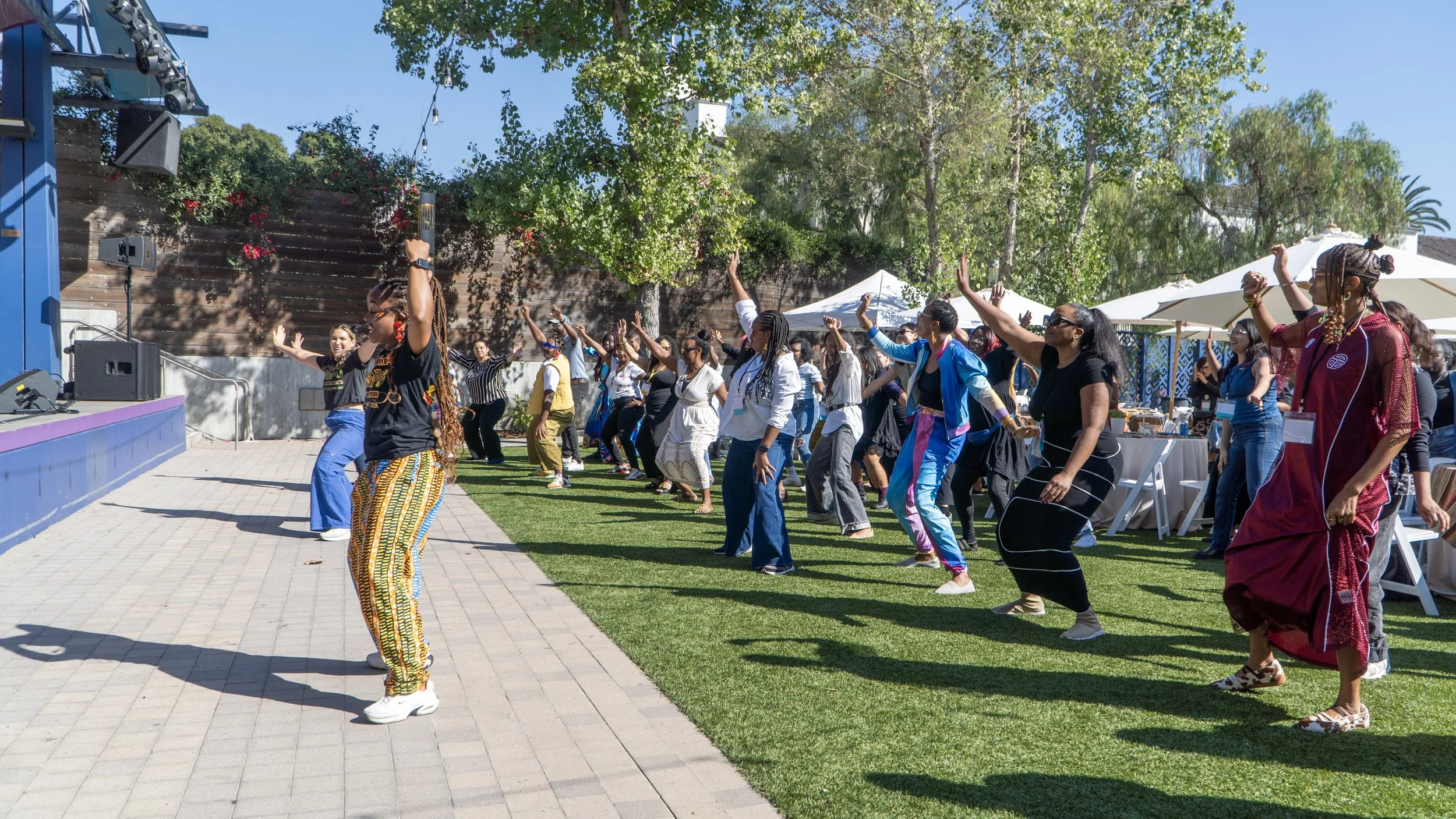
Photo by Des Lee
In joyUS justUS, we reclaim stories of joy collected directly from communities of color in South Los Angeles - not as sentiment, but as resistance. Joy, we insist, is not a luxury we earn after the struggle is over. Joy is the struggle. The daily insistence that our humanity is not negotiable.
In ¡azúcar!, we go deeper into the body's memory - into the complicated, painful, beautiful history encoded in Afro-Latine movement itself. We trace the story of sugar: from its origins as a healing plant, to its weaponization as a tool of colonial extraction, to the ancestral wisdom still living in our bodies on the other side of that history. It is a truth-telling. A reckoning. And always, ultimately, a celebration.
And in Roots of Loving Us, our newest work, created in collaboration with Holly Johnston of Responsive Body - we turn toward the intimate, foundational question of family itself. Two women of color, mothers, activists, and community leaders, joining forces to explore origin stories shaped by biological uprooting, unchosen separation, and the re-rooting of bodies. Through somatic healing and ancestral technologies of dance, music, and imagery, Roots holds space for adoption, foster families, queer parents, single-parent families, and diverse birthing experiences - honoring the enduring, transformative choice to love forever.
Three works. One through-line: the body as archive, as medicine, as site of liberation.
Art as a Technology of Survival
Zinn believed that political power belongs to those who control the narrative - and that art is where the counter-narrative lives. He described the arts as the site of a kind of guerrilla warfare, a place where those without institutional power can find openings, create apertures, and have an effect. He wasn't speaking romantically. He was speaking strategically.
We use the phrase "ancestral technologies of resistance" to describe what we do. It's not metaphor. It's history.
The Afro-Latin diaspora traditions at the root of our movement vocabulary were not developed in safety. They were developed under enslavement, under colonization, under conditions designed to break the human spirit. Our ancestors encoded survival in their dance. They encoded communication, defiance, prayer, and love in the way they moved their bodies when everything else had been taken.
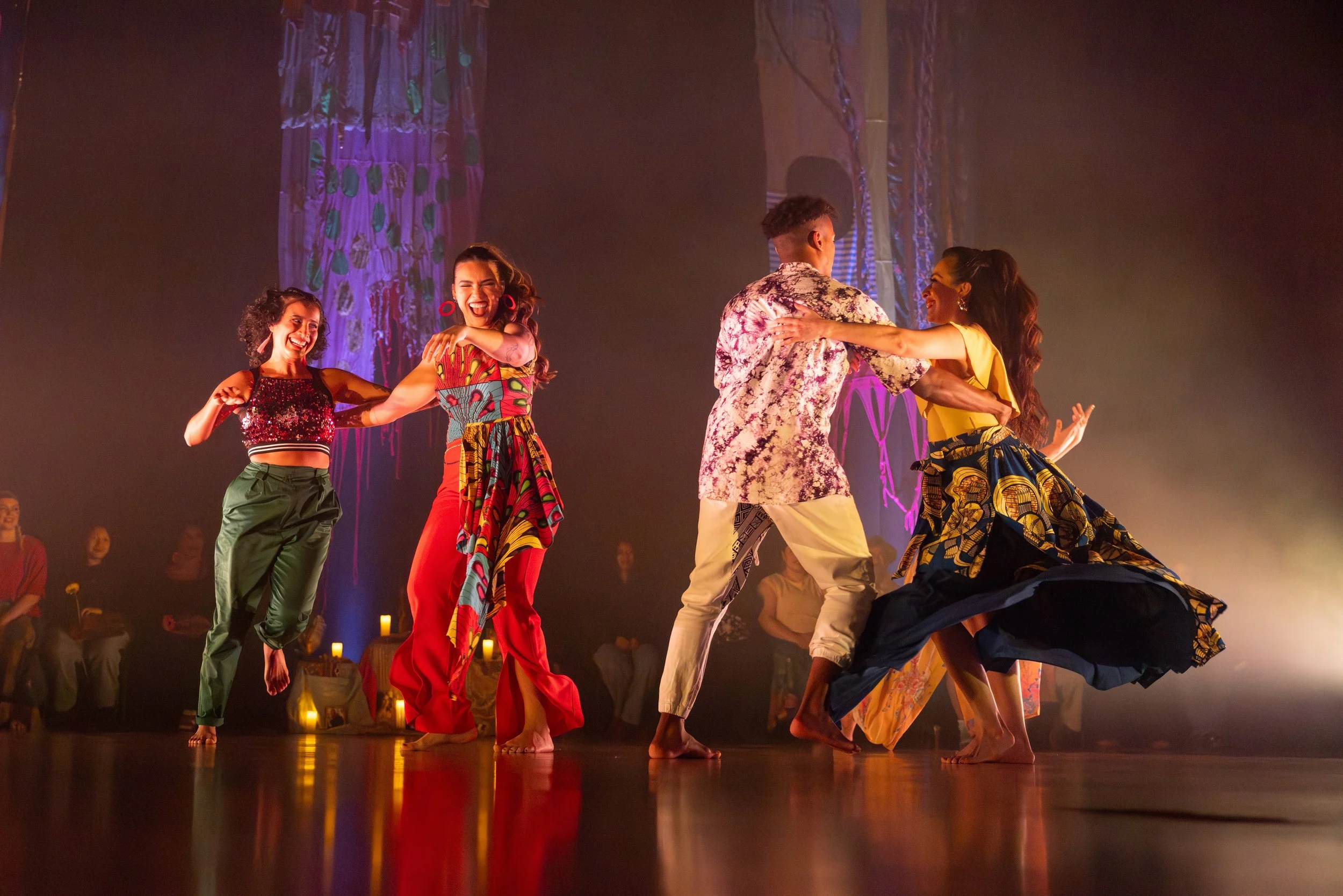
photo by Brennan Sparks
We are the inheritors of that technology. And we believe - with everything we have - that it is exactly what this moment requires.
Not instead of organizing. Not instead of showing up at city hall or making phone calls or donating to bail funds. ALONGSIDE all of that. As a reminder of why we do it. As a practice of becoming the kind of people who can sustain a long fight.
Zinn put it plainly: all of us, no matter what we do, have the right to make moral decisions about the world. Not just scholars. Not just politicians. Artists. Dancers. The grandmother who steps into the circle. The teenager with their arms crossed who, slowly then all at once, starts moving. We do not need permission from experts or institutions to name what is wrong - and we do not need it to imagine something better.
What We See, Every Time
We see it after every performance, in every community we enter.
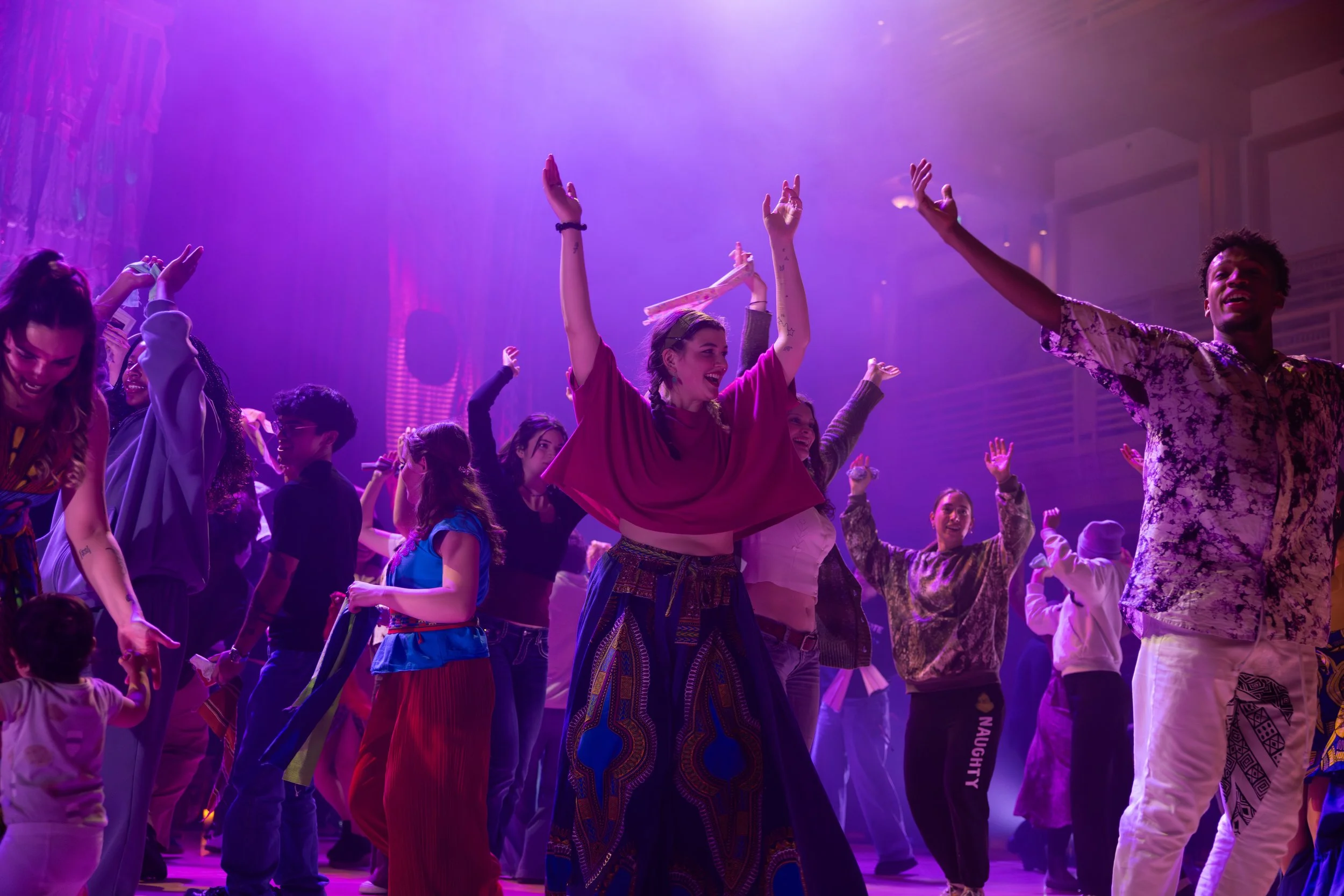
We see what happens when art goes to the people instead of asking the people to come to it. We see grandmothers who haven't danced in thirty years step into the circle. Fathers lifting daughters onto their shoulders. Folks who came skeptical leaving changed. People who cry and laugh at themselves for crying and then cry again.
We see what Zinn meant when he wrote about art's capacity to transcend the immediate - not to ignore suffering, but to insist on something larger than it. When joyUS justUS fills a plaza with movement and reclaimed stories, that is the aperture. When ¡azúcar! calls out anti-Blackness in latinidad and refuses to look away, that is the counter-narrative. When Roots of Loving Us holds a queer parent or an adoptee and says your family is a revolution - that is the vision of what is possible.
This is what activist dance theater is for. Not just the big venues, not just the festival stages. Wherever people are willing to gather and move together toward something better.
So: How Do We Keep Dancing?
We keep dancing because we don't know another way to tell the truth as completely.
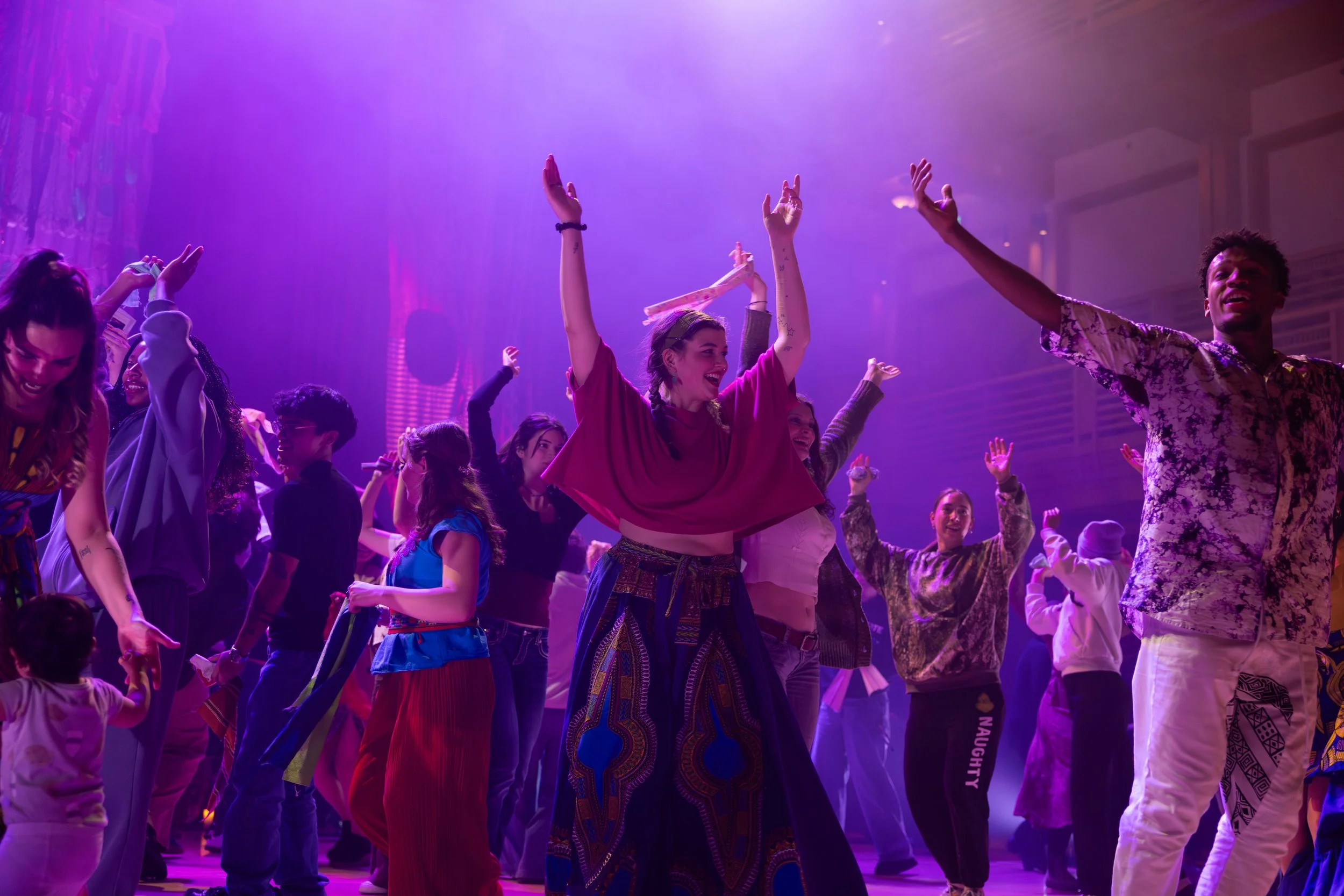
photo by Brennan Sparks
We keep dancing because our company members need it - need the rehearsal room, need the sweat, need each other - as much as any audience does.
We keep dancing because every time we think about stopping, someone in the community tells us what the work meant to them. A teacher who uses our residency curriculum. A young student who saw joyUS justUS and decided to study dance. A parent who says: my kid came home different after that class. An audience member after ¡azúcar! who says: I finally feel seen. Someone who found themselves in Roots of Loving Us and understood, maybe for the first time, that their family story belongs on a stage.
We keep dancing because grief and joy can live in the same body at the same time, and that's not a contradiction - that's the whole point.
Zinn argued that to criticize the government, to refuse the official story, to insist on a different vision of the world - this is the highest form of patriotism. We would say: to dance in defiance of a world that wants to erase you is the highest form of love.
And we keep dancing because, as Ana María has said for as long as we've been a company: making the revolution irresistible is the most radical thing we can do.
The world is hard right now. It has always been hard for the people we make work for and with. And we will keep showing up - in community spaces, on concert stages, in schools and plazas and theaters - as long as there are bodies willing to move together toward something better.
Con amor y resistencia,
CONTRA-TIEMPO